- The Decanter has one goal and that is to fill the glasses at the dining table. There aren't many but it has to get to them first. It'll have to dodge obstacles and jump from place to place in order to reach the table as well as the glasses. This will all be choreographed, hopefully, to flow alongside the Mission Impossible theme tune (http://www.youtube.com/watch?v=JSsnLUSag7g&feature=related), as found by Phil. There will be jumping, sliding and swinging, all going well, and it will be amazing! :D

Thursday, 10 March 2011
Onwards to Decanting!
New story idea! Thanks to some refreshing help from Phil I now have another story and it's much better:
The idea is pretty simple but that's all it needs to be! I'm feeling much more confident now. Once I have my design as well I'll be well on my way to getting my storyboarding and animatic done :P

Research into 'Nimble'...
As I'm struggling a little bit with ideas, here's a little bit of research into the meaning of the word 'nimble' and see where it takes me:
"nim·ble [nim-buh l]
l]
1. Quick and light in movement; moving with ease; agile; active;rapid: nimble feet.
2. Quick to understand, think, devise, etc.: a nimble mind.
3. Cleverly contrived: a story with a nimble plot.
"nim·ble
adj. nim·bler, nim·blest
1. Quick, light, or agile in movement or action; deft: nimble fingers. See Synonyms at dexterous.
2. Quick, clever, and acute in devising or understanding: nimble wits. "
(From: http://www.thefreedictionary.com/nimble)
Origin and History to the words of Jack be nimble
"The most commonly agreed origin for the Jack be nimble rhyme is the connection to Black Jack, an English pirate who was notorious for escaping from the authorities in the late 16th century hence Jack be nimble... The words of the Jack be nimble rhyme cannot be further analysed due to the brevity of the text of the lyrics but could be associated with the old tradition and sport of 'candle leaping' which used to be practised at some English fairs."
"The tradition of candle-leaping originated from an old game of jumping over fires. This dangerous game was banned and replaced by the far less dangerous sport of Candle leaping...The first publication date for Jack be nimble is 1798."
"nim·ble [nim-buh
l]1. Quick and light in movement; moving with ease; agile; active;rapid: nimble feet.
2. Quick to understand, think, devise, etc.: a nimble mind.
3. Cleverly contrived: a story with a nimble plot.
Origin:
before 1000; late Middle English nymel, earlier nemel, Old Englishnǣmel capable, equivalent to nǣm- (variant stem of niman totake)"
before 1000; late Middle English nymel, earlier nemel, Old Englishnǣmel capable, equivalent to nǣm- (variant stem of niman totake)"
"nim·ble
adj. nim·bler, nim·blest
1. Quick, light, or agile in movement or action; deft: nimble fingers. See Synonyms at dexterous.
2. Quick, clever, and acute in devising or understanding: nimble wits. "
(From: http://www.thefreedictionary.com/nimble)
Jack Be Nimble:
 |
| Fig. 1 Illustration of Jack Be Nimble, the nursery rhyme. |
Origin and History to the words of Jack be nimble
"The most commonly agreed origin for the Jack be nimble rhyme is the connection to Black Jack, an English pirate who was notorious for escaping from the authorities in the late 16th century hence Jack be nimble... The words of the Jack be nimble rhyme cannot be further analysed due to the brevity of the text of the lyrics but could be associated with the old tradition and sport of 'candle leaping' which used to be practised at some English fairs."
"The tradition of candle-leaping originated from an old game of jumping over fires. This dangerous game was banned and replaced by the far less dangerous sport of Candle leaping...The first publication date for Jack be nimble is 1798."
My decanter needs to seem quick, either in wits or speed, or even both. I'm trying to keep it slim so it looks sleeker and as if it would be faster but I'm still unsure as to how I'll go about portraying it well enough.
List of Illustrations
Figure 1. Illustration of Jack Be Nimble, the nursery rhyme. At: http://rockhousefarm.co.uk/play/jack.html (Accessed on 10.03.11)
Story Ideas for 'The Nimble Decanter'...
My first ideas all revolve around the same thing really.
- The decanter sees a perfume bottle at the other end of the room and decides it wants to get to it and in order to do so it has to duck and dodge many obstacles on the way such as ornaments, chairs and doors etc.
- It could end in different ways, either it manages to get to the perfume bottle in time and it's all happy or there's a 'swing and a miss' situation where it falls just short and spills everywhere, very sad.
- The themes this idea could have is a sort of military one where it's much like an obstacle course where there will be drum rolls and trumpets, something along the lines of the great escape music or Blackadder goes Forth. Another is a kind of James Bond, Mission Impossible theme. Pretty much the same as the military one but slightly different music and movements maybe.
- One other idea I had is to have a dream sequence of the decanter reaching the perfume bottle but then revealing that it's still trapped in its display cabinet.
Am I being too complicated and missing something simple? I'm not sure. Help is much appreciated though!
A Few More Shapes...


A Study of Winsor McCay...
 |
| Fig. 1 Image of the Mosquito at work. |
Winsor McCay can be considered the father of animated film. There were few before him, J. Stewart Blackton is perhaps the only one, as he created animated chalk faces in Humorous Phases of Funny Faces in 1906. One of McCay's first works was How a Mosquito Operates, an amazing but definitely disturbing use of animated line drawings. Paul Wells believed that it was "Arguably, the first animated 'horror film, featuring a vampiric mosquito. and consolidating McCay's technique drawn from his skills as a draughtsman and illustrator." (Wells, 2002:115) First revealed in 1912, it was a real example of what can be achieved simply through illustration and how graphic only a few lines can be. Wells also expressed that "the close-up depiction of Winsor McCay's vampiric mosquito...is enough to draw the film into a consideration of it's place as a 'horror' film." (Wells, 2002:48) The audience watches this well-to-do looking mosquito as he sharpens his nose and then horribly and slowly stabs it into the sleeping man's face and head. The timing is key to creating the unsettling tone as the audience knows what it will do, but they are left sitting for too long before anything happens, building up the tension.
 |
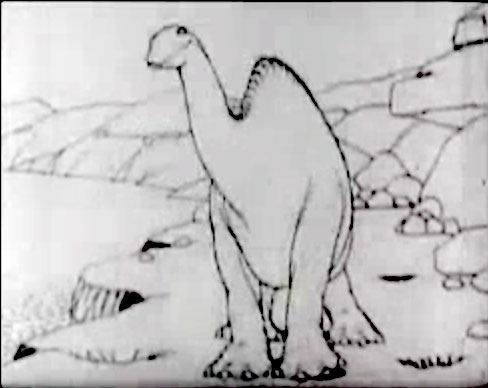
| Fig. 2 Image of Gertie. |
The second, and possibly most famous animation of McCay's is Gertie, from his 1914 animation Gertie the Dinosaur. In this animation, not only does he bring to life an extinct life form with two other characters, but he also created the biggest amount of drawings for an animated film ever. Michael W. Brooks explained that "his major contribution to the mass media came...when he produced more than ten thousand pencil sketches to animate 5 minutes of film in Gertie the Trained Dinosaur - the first animated cartoon to feature an animal." (Brooks, 1997:96) This animation, to this day, is full of charm and its simplicity only adds to its appeal to the audience. McCay creates a wholly imaginary world in this film and it is through the animations simplicity of its line drawings that McCay can place himself into the animation in a clear visual way. J.P. Telotte divulged that the "moment of entry is certainly one of the most effective parts of the film, an unexpected "topper" for all the other tricks Gertie has done and a hint of the attraction that inheres in the deep - and still unexplored - space of the frame." (Telotte, 2010:28) The audience is introduced to Gertie, she is his disobedient pet that is supposed to perform tricks for him when she asks but her cheeky personality still shines through. It is the real personality that Gertie has that makes it, not only believable ,but incredibly fun when McCay steps into the animation and she picks him up and rides away with him on her back.
 |
| Fig. 3 Image from The Sinking of the Lusitania. Possibly one of McCay's most powerful animations is The Sinking of the Lusitania from 1918. This is the first example of an animated film based on real events and it is because of this that it is so powerful to watch. The Lusitania was a british liner that was carrying civilians as well as a few popular celebrities of the time. McCay was so affected by this loss thousands of innocent lives that he wanted to portray it in film and express his disgust to the whole world. It's another solely black and white film, but this time it doesn't appear to be simple line drawings, the ship even has rotoscope quality to it as it sits tall on the water. The animation's appearance, Tellotte has mentioned, is much like the appearance of illustrations and images in the newspapers of the time, and as this was during a time of war and great fear this made it all the more effective for the audience. Telotte then goes on to explain that McCay "uses the stylistic possibilities implicit in that real space of anxiety to add a further unsettling dimension, as if the submarine lurking in those depths were metaphoric of some other sort of anxiety or threat that was more difficult to articulate or visualise." (Telotte, 2010:49-50) That threat could be the fear of invasion by the Germans. This animation is a piece of propaganda to make sure the audience is sufficiently scared and angry at the opposing forces. The use of tragic music alongside the images of people falling, drowning and being killed in the explosions completely adds to the terror they must be feeling. To create this animation McCay made over 25,000 drawings and that grand effort is clearly visible in the flowing smoke and raucous waters of the sea. All of these animations are incredibly important to the foundation of animation. Without these seemingly simple moving images animation wouldn't be where it is today, and perhaps not as easy to access too. |
Figure 1. How a Mosquito Operates (1912) Image of the Mosquito at work. At: http://matineeatthebijou.blogspot.com/2009/07/winsor-mccay-animation-pioneer.html (Accessed on: 09.03.11)
Figure 2. Gertie the Dinosaur (1914) Image of Gertie. At: http://www.rareresource.com/movies/Gertie_The_Dinosaur.jpg (Accessed on: 09.03.11)
Bibliography
Telotte, J. P. (2010) Animating space: from Mickey to Wall-E. Kentucky: The University Press of Kentucky.
Brooks, Michael W. (1997) Subway city: riding the trains, reading New York. New Jersey: Rutgers University Press.
Wednesday, 9 March 2011
Rough Decanter Shapes...


Previously, In Life Drawing...
After the first drawing I tried to focus more on exaggerating the shapes and gestures than realism and I think my drawings are much more interesting because of it :)


Subscribe to:
Posts (Atom)